

Agentic AI: Why the Next Era of Technology Belongs to Autonomous AI Agents
For the last few years, the conversation around artificial intelligence has been dominated by chatbots and content generators — tools that respond when asked, wait for the next prompt, and never truly act on their own. That era is ending. The next wave, Agentic AI, is not about AI that answers questions. It’s about AI that takes action, makes decisions, and completes entire workflows on its own, with little to no human supervision.
At Solexes, we believe agentic AI isn’t a passing trend — it’s the foundation of how every serious digital business will operate within the next few years. This blog breaks down what agentic AI actually is, how it differs from the AI tools most businesses already use, why it matters right now, where it’s already changing industries, and how Solexes is positioning itself to lead this shift for the businesses we work with.
What Is Agentic AI?
Agentic AI refers to AI systems — often called AI agents — that can independently plan, reason, and execute multi-step tasks to achieve a goal, instead of simply generating a single response to a single prompt. A traditional AI tool might summarize a document when asked, translate a paragraph, or draft an email for a human to review and send.
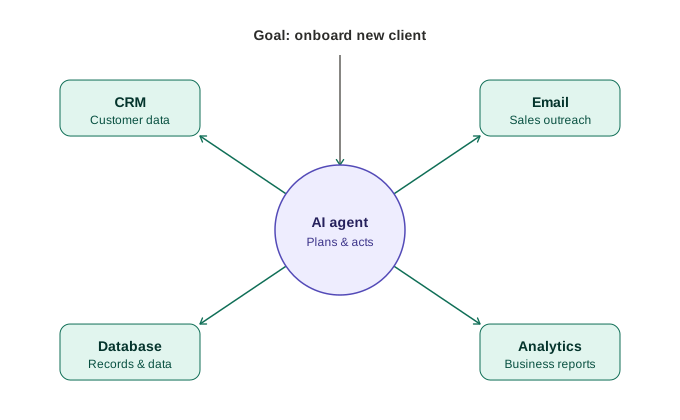
An AI agent, on the other hand, can be given a goal like “onboard this new client” and will independently break that goal into smaller steps, decide which tools or systems it needs, execute those steps in the right order, check its own output for errors, adjust its approach if something doesn’t go as planned, and only report back once the task is genuinely complete.
This shift — from AI that answers to AI that acts — is what separates agentic AI from the generative AI wave that came before it. Generative AI produces content. Agentic AI produces outcomes. That distinction sounds small on paper, but it changes almost everything about how a business can use artificial intelligence day to day.
The word “agentic” itself comes from the idea of agency — the capacity to act independently and make choices. An agentic system isn’t just following a fixed script line by line. It’s reasoning about the best way to reach a goal, adapting when circumstances change, and often coordinating with other tools, APIs, or even other AI agents along the way.
How Agentic AI Is Different From Traditional Automation
It’s worth pausing on this, because agentic AI often gets confused with the automation tools businesses have used for years. Traditional automation — think rule-based workflows, “if this happens, then do that” logic, or robotic process automation — is powerful, but rigid. It only works exactly the way it was programmed to, and it breaks the moment something unexpected happens outside its predefined rules.
Agentic AI behaves differently because it reasons rather than just executes. If an agent is tasked with resolving a customer complaint and the standard resolution path doesn’t apply, it can evaluate the situation, consider alternative approaches, and choose a reasonable path forward instead of simply failing or escalating everything to a human. That reasoning layer, powered by large language models and decision-making frameworks, is what gives agentic AI the flexibility that traditional automation has never had. It’s less like a fixed script and more like a capable employee who understands the goal, not just the steps.
Why Agentic AI Is the Next Big Shift in Business Technology
Chat-based AI needs a human to drive every single step. Agentic AI can own a process end-to-end — monitoring a support inbox, following up with leads, reconciling data across systems, or managing a marketing calendar — the way a junior employee would, but continuously, without breaks, and at a scale no human team could match.
What makes this possible is that real agentic AI is built to interact with a business’s actual tools: CRMs, databases, internal APIs, email systems, and e-commerce platforms. That’s what turns AI from a novelty feature into an operational asset rather than just a chat window sitting on a website.
This also reduces the human bottleneck in repetitive decision-making. Where generative AI produces a draft for a human to review, agentic AI can make bounded decisions itself — approving a routine request, flagging an anomaly in a dataset, or rerouting a task to the right department — and escalate only when a genuine human judgment call is needed. Employees stop spending their day on repetitive, low-value decisions and start spending it on the exceptions and the strategic work that actually needs a human mind.
There’s also a cost and speed argument that’s hard to ignore. A process that used to take a team several hours to complete manually can often be handled by an agent in minutes, running in parallel across dozens of cases at once. For growing businesses, that kind of leverage is difficult to achieve through hiring alone.
It’s a big enough shift that the entire tech industry, from enterprise software vendors to cloud providers, is now building its roadmaps around agent-based architecture. Every major AI lab and platform provider is investing heavily in agent frameworks, tool integrations, and orchestration layers designed specifically to let AI systems act rather than just respond.
Businesses that adopt agentic workflows early will have a structural advantage over competitors still relying on manual processes or single-shot AI tools that stop working the moment a human looks away.
Where Agentic AI Is Already Making an Impact
Agentic AI is already showing up across a wide range of business functions, and the pattern is consistent: wherever there’s a repetitive, multi-step process that currently depends on a person moving information between systems, there’s an opportunity for an agent to take it over.
In customer support, agents are resolving tickets end-to-end instead of just suggesting replies for a human to approve — pulling order history, checking policies, issuing refunds where appropriate, and closing the loop without a human ever touching the ticket.
In sales and marketing, agents research leads, personalize outreach at a scale no individual rep could match, and manage follow-up sequences automatically based on how a prospect responds. In operations, agents are being used to monitor inventory levels, adjust pricing based on demand signals, or flag supply chain issues and take corrective action before a human even notices the problem.
Software development is another area where agentic AI is advancing quickly. Agents can now write code, run tests, catch bugs, and even open pull requests within defined guardrails, effectively acting as a tireless junior developer working alongside a human team. Reporting and analytics are changing too, with agents pulling data from multiple disconnected sources, cleaning it, and generating decision-ready insights without someone spending an afternoon compiling spreadsheets.
Even internal operations like HR onboarding, IT ticket triage, and financial reconciliation are starting to be handled by agents that understand the process end to end rather than a single isolated task within it.
How Solexes Is Building the Agentic AI Era
Agentic AI isn’t something a business can bolt on with a single tool or a quick plugin — it requires the same discipline as any serious software system: solid architecture, secure integrations, careful permissioning, and full-stack engineering behind the scenes.
This is exactly where Solexes operates. As a technology company built around full-stack, AI-enabled development, Solexes is actively focusing its roadmap on agentic AI because we see it as the direction the entire industry is moving toward, not a feature to be added on as an afterthought.
Our approach centers on custom AI agent development designed around a business’s real workflows rather than generic, one-size-fits-all bots pulled off a shelf. Every business runs differently, and an agent that isn’t built around the actual way a company operates ends up being more of a demo than a working system.
We pair that custom development with full-stack integration that connects agents securely to a company’s existing systems, databases, and APIs, so they can actually take action inside the tools a business already relies on, not just talk about taking action.
We also layer in machine learning and predictive intelligence so that agent behavior genuinely improves over time instead of staying static. An agent that learns from outcomes — which approaches worked, which didn’t, which edge cases keep coming up — becomes more valuable the longer it runs.
And because agentic systems are making real decisions inside a live business, we back all of this with managed AI operations: ongoing monitoring, security oversight, and support so these systems stay reliable, stay within their intended boundaries, and stay aligned with business goals as they scale.
We’re not treating agentic AI as a buzzword to attach to our services because it’s trending. It’s becoming a core part of how we plan to build for our clients going forward, because we believe the companies that adopt agent-driven systems early will be the ones setting the pace in their industries over the next several years, while the ones who wait will be playing catch-up.

Common Concerns Businesses Have About Agentic AI
It’s natural for businesses to have questions before handing any real decision-making over to an AI system, and those concerns are worth addressing directly rather than glossed over. The most common one is control — the worry that an agent might take an action a business never intended. This is why properly engineered agentic systems are built with clear boundaries from day one, defining exactly which actions an agent can take independently and which ones require a human to approve first.
Another common concern is reliability, especially in industries where mistakes carry real financial or reputational cost. This is addressed through monitoring, logging, and testing practices that treat an AI agent the same way a serious engineering team would treat any other piece of production software, not as an experimental toy.
Data security is a related concern, particularly when agents are connecting to sensitive systems like CRMs or financial databases, and it’s handled through proper access controls, encryption, and the same security discipline that should already govern any integration between business systems.
The businesses that get the most value from agentic AI tend to be the ones that start with a well-defined, bounded process rather than trying to automate everything at once. Starting narrow, proving the system works reliably, and then expanding its scope tends to build both trust internally and a stronger technical foundation than trying to hand an agent broad authority from the very beginning.
The Road Ahead
Agentic AI is still an emerging space, and the businesses experimenting with it now are the ones who will understand it best when it becomes standard practice — much like early adopters of cloud computing or mobile-first design did in previous technology shifts. The gap between companies that treat AI as a chat window and companies that treat AI as an operational layer inside their business is only going to widen over the next few years.
At Solexes, our focus is on making sure the businesses we work with aren’t just watching this shift happen from the sidelines, but building with it from the start, so that when agentic AI becomes the industry standard, it isn’t a scramble to catch up but simply the natural next step in a system they’ve already been building.
Frequently Asked Questions
What is the difference between generative AI and agentic AI? Generative AI creates content or responses based on a prompt. Agentic AI goes further — it plans and executes multi-step tasks toward a goal, often interacting with real systems and tools without needing a human to guide every step.
Is agentic AI safe to use in a business without human oversight? Agentic AI systems are typically built with defined boundaries, approval checkpoints, and monitoring, so businesses retain control over which decisions an agent can make independently and which ones still require human sign-off.
How can a business start adopting agentic AI? The most practical starting point is identifying one repetitive, multi-step workflow — such as lead follow-up or support triage — and building a focused AI agent for that specific process before scaling to others.
Does Solexes build custom AI agents for businesses? Yes. Solexes designs and develops custom AI agents as part of its full-stack AI-enabled development services, tailored to each client’s existing systems and workflows.